
 Mujeeb

How to start a SaaS business is mostly a sequencing problem. Most failed products were not badly built — they were built in the wrong order: code first, customers later, pricing as an afterthought. This guide lays out the order that gives a solo founder or tiny team the best odds: find a painful problem, prove people will pay for the fix, price it, build the smallest useful version, and recruit your first customers by hand before you automate anything.
It is written for bootstrapped founders building without funding or a big team. If you plan to raise venture capital and hire twenty people, parts of this still apply, but the funding route changes several steps. Where a step deserves a full guide of its own, this article hands off to our dedicated deep-dives rather than repeating them — think of it as the map, with the detailed routes linked at each junction.
Short answer: pick one painful problem for one specific audience, validate it with real conversations and a pre-payment test, charge from day one, build an MVP that does one job well, and get your first 10 customers manually. Everything else — brand, growth channels, hiring — comes after those five things, not before.
The roadmap at a glance
| Step | What you produce | Indicative time (part-time) |
|---|---|---|
| 1. Find the problem | A one-sentence problem statement for a named audience | 1–2 weeks |
| 2. Validate | Interview notes + a pre-sale or waitlist with real commitment | 2–4 weeks |
| 3. Model & price | A pricing page draft with tiers and a target customer count | A few days |
| 4. Choose your build route | A decision: code it, no-code it, or hire it — with reasons | A few days |
| 5. Build the MVP | One working workflow, ugly but usable | 4–8 weeks |
| 6. Business basics | Entity, bank account, payment processing, basic policies | 1 week, in parallel |
| 7. Launch | A public release to the audience you built while validating | 1–2 weeks |
| 8. First 10 customers | Hand-recruited paying users and their feedback | 4–8 weeks |
| 9. Measure & iterate | MRR, churn and activation tracked weekly | Ongoing |
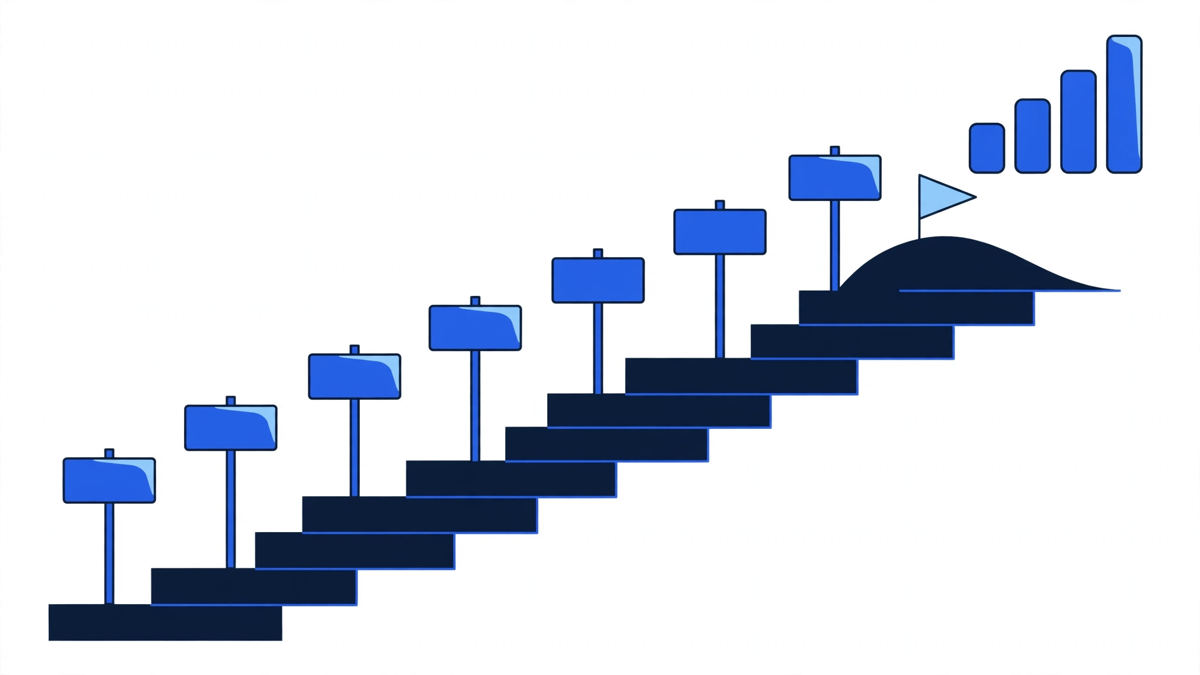
The times are planning ranges for someone building alongside a job, not benchmarks — a full-time founder compresses them, a complex product stretches them. What matters is the order: each step de-risks the next, and skipping ahead is how solo founders burn months.
Step 1: Start with a problem, not an idea
Ideas are cheap and usually wrong in their first form. Problems are observable: someone, somewhere, loses time or money every week to a workflow that frustrates them. Your first job is to find one such problem, in one specific audience you can actually reach — a profession, a hobby-business niche, a type of small company — and state it in one sentence: who hurts, when, and what it costs them.
If you need raw material, work through problem spaces rather than brainstorming app names: our 150+ SaaS ideas pillar organises opportunities by niche, and the pattern behind the strongest entries is always the same — a narrow audience with a recurring, expensive annoyance. Write down ten candidate problems, then rank them by three questions: How often does it hurt? What does the workaround cost today? Can I reach ten sufferers this month? The winner is rarely the most exciting idea; it is the one you can test fastest.
Step 2: Validate before you build
Validation is where most of the risk in a SaaS business dies — cheaply. Talk to at least ten people who have the problem. Ask about their current behaviour, not your future product: how they handle it now, what it costs, what they have tried. Then raise the stakes: a landing page describing the outcome, with a price and a button. Clicks are compliments; email addresses are interest; a deposit, a paid pilot or a signed letter of intent is validation.
This step decides whether steps 3–9 happen at all, so it gets the full treatment in our dedicated guide: how to validate SaaS ideas covers the interview method, the smoke tests and the 20-point checklist in detail. Do not skip it because the conversations feel slow — they are the fastest part of this entire roadmap, and they double as building your launch audience.
Step 3: Pick a model and a price before the MVP
Pricing is not a launch-week decision; it shapes what you build. Decide three things now:
- Who pays and for what unit — per user, per location, per month of usage, per outcome. The unit should grow as the customer gets more value.
- A price you can say out loud. If you cannot yet justify a number, interviewees’ current workaround cost is your anchor: your price should look small next to the problem’s cost and large enough that ten customers matter.
- Tiers with a reason to upgrade. One tier is a hobby; two or three tiers with a genuine capability step between them is a business.
Our step-by-step guide to how to price a SaaS product works through the models, the packaging and a full worked example. The discipline that matters here: charge from the first real user. Free beta testers give polite feedback; paying customers give true feedback.
Step 4: Decide how you will build it
There are four realistic routes for a solo founder, and none of them is “the right one” — they trade money, time and control differently:
- Code it yourself. Cheapest in cash, most expensive in your hours, total control. The right route if you already have the skills; a trap if step one of your startup becomes “learn to code for six months”.
- No-code / low-code builders. Fast to a working product for workflow-style tools; you rent speed in exchange for platform limits and per-app costs. Entirely legitimate for an MVP, and often for the business itself. (Connecting the pieces usually means an automation tool — our Zapier vs Make vs n8n comparison shows how their pricing really works.)
- A freelancer. Middle cost, variable quality; works best with a brutally specific scope document — which is exactly what step 5 produces.
- An agency. The most expensive route and the least learning. Agencies quote MVP builds at prices that end most bootstrapped projects before they start, and you still have to do steps 1–3 yourself — an agency cannot validate your market for you. For a first bootstrapped product, treat this as the last resort, not the default.
Whichever route you choose, the decision rule is the same: pick the one that gets a real user in front of a working core workflow soonest, because everything you believe before that moment is a hypothesis.
Step 5: Scope an MVP that does one job
Your MVP is not “the product, but smaller”. It is the single workflow your validated audience asked for, done completely, with everything else cut. Write the feature list from your interview notes, then delete every feature that is not required for a paying user to get the core outcome on day one. Onboarding polish, integrations, dashboards, settings pages — all of it waits until a customer asks twice.
Two practical rules keep MVPs honest. First, manual behind the curtain is fine: if a step happens twice a month, a human (you) can do it behind an automated-looking interface while you learn whether it deserves code. Second, set a ship date and cut scope to meet it, never the reverse — a launched MVP with three features teaches you more in a week than a perfect one teaches in a quarter.
Step 6: Set up the business basics
Unglamorous, unavoidable, and cheaper to do once, properly, than to retrofit. The checklist for most solo founders:
- A legal entity and a business bank account, so business money never mixes with personal money. The right structure depends on your country and situation — this is general information, not legal or tax advice; a short consultation with a local accountant is money well spent.
- Payment processing through an established processor, so you can charge cards and handle subscriptions, taxes and failed payments without building billing yourself. Processors charge a percentage of each transaction — fine at your scale, and the correct problem to have.
- The basic documents: terms of service and a privacy policy that honestly describe what data your product stores. If your tool touches customer data of any sensitivity, describe it plainly and store as little as you can.
- A domain, email on that domain, and analytics from day one, so every later decision has data behind it.
Do this in parallel with building, not before validating — an entity for a product nobody wants is just paperwork.
Step 7: Launch to the audience you already built
A launch is not a press release; it is telling specific people, who already told you they have this problem, that the fix exists. Your validation interviews produced exactly that list: every interviewee, every waitlist signup, every community where you asked questions along the way. Email them personally, post the story of the problem and the build in those same communities, and list on launch platforms as a bonus — not as the strategy.
Expect a modest first wave and treat it as raw material, not a verdict. The founders who win this phase are the ones who watch what the first users actually do, fix the top friction within days, and tell those users they fixed it. Momentum in week two matters more than spikes on day one.
Step 8: Get your first 10 customers manually
Ten paying customers, recruited by hand, teach you more than a thousand anonymous signups. Paul Graham’s classic advice to do things that don’t scale was written for exactly this phase: recruit users one at a time, onboard them personally, do the unscalable favours, and extract the truth about why they stay or leave from real conversations.
Practically: work your interview list first (they have the problem and know your face), then the communities and directories where your audience gathers, then partnerships with adjacent tools and service providers who already serve your customer. Price holds during this phase — discounts to close your first ten are fine if they are time-limited and buy you feedback and a testimonial, not if they become your real price. The founder community at Indie Hackers is full of first-customer playbooks from people who did this recently and wrote down what worked.
Step 9: Measure the few numbers that matter
Once money moves, three numbers run your week:
- MRR (monthly recurring revenue) — is the business growing, flat, or shrinking?
- Churn — what share of customers cancel each month? Early on, talk to every single one who leaves; the reason is your roadmap.
- Activation — what share of new signups reach the moment the product delivers its core value, and how fast? Improving this usually beats acquiring more signups.
Review them weekly, change one thing at a time, and resist buying growth (ads, sponsorships) until the product keeps the customers it gets. Retention first; acquisition spend poured into a leaky product is the most expensive lesson in this business. As operations grow, automate the repetitive edges — billing reminders, onboarding emails, data syncing — with the automation tools compared in step 4, and keep your own hours for product and customers.
What starting actually costs
The honest answer is “your time, plus a modest stack of subscriptions” for the bootstrapped route — anyone quoting you a single universal figure is selling something. The cash costs cluster into five buckets:
| Cost bucket | What it covers | Bootstrapper’s note |
|---|---|---|
| Formation & admin | Entity registration, basic accounting | One-off plus a small annual cost; varies by country |
| Infrastructure | Domain, hosting, email, analytics | Starts near the cost of a few coffees a month at MVP scale |
| Build tools | Your stack, design tool, no-code platform if used | Free tiers cover the MVP surprisingly often |
| Payment processing | Percentage of each transaction | Costs nothing until you earn — the right kind of cost |
| Your hours | Evenings/weekends or full-time runway | The real budget. Price your time honestly before choosing a build route |
What changes the total by orders of magnitude is step 4’s decision: building it yourself keeps cash costs in the buckets above; hiring the build out — especially through an agency — turns it into the largest line by far. Neither is automatically wrong, but only one of them is survivable without funding.
Mistakes that end solo SaaS projects early
- Building for months before charging anyone. Every week without a price is a week without information.
- Solving a problem you find interesting instead of one a reachable audience finds painful. Distribution beats novelty at this scale.
- Copying a funded competitor’s playbook. Their free tier, content team and ad budget are not a strategy available to you.
- Quitting the day job on a date instead of a milestone. Validation plus paying customers is a milestone; frustration is not.
- Tracking vanity numbers. Signups and followers feel like progress; MRR and churn are progress.
Frequently asked questions
How much money do I need to start a SaaS business?
There is no universal figure, because the answer is dominated by one decision: whether you build it yourself. A bootstrapped solo founder who codes (or builds no-code) typically faces the five cost buckets in the table above — formation, infrastructure, tools, processing fees and above all their own time. Hiring the build, particularly through an agency, multiplies the cash requirement and is the route that ends most unfunded projects. Start from your build route and your runway, not from a headline number.
How long does it take to start a SaaS business?
The roadmap table gives indicative part-time ranges: roughly two to four months from problem to a launched MVP for a focused product, with the first ten customers taking as long again. Full-time founders move faster; regulated or integration-heavy products move slower. The order of the steps matters more than the speed of any single one.
Do I need to know how to code to start a SaaS business?
No. No-code and low-code platforms can carry a workflow product a long way, and freelancers can build what you cannot. What you cannot outsource is the judgement: problem selection, validation, pricing and scope decisions are the founder’s job on every route. Many successful solo products started no-code and were rebuilt later, once revenue justified it.
Should I quit my job to start a SaaS business?
Not on a date — on evidence. The safer sequence is: validate in your evenings, build the MVP alongside the job, and treat “strangers are paying me monthly and support load is growing” as the signal. A salary is runway, and runway is the scarcest resource a bootstrapped founder has; spend it deliberately.
Do I need funding to start a SaaS business?
No — funding is one strategy, not a requirement, and it changes the business you have to build (growth expectations, exit horizon, governance). Bootstrapping keeps the company yours and forces the discipline this guide describes: charge early, keep costs in the small buckets, grow at the speed customers fund. Many healthy SaaS businesses never raise at all.
What is the hardest part of starting a SaaS business?
For most solo founders it is not the technology — it is distribution: getting the first strangers to care. That is why this roadmap front-loads audience contact (validation interviews become your launch list) and treats hand-recruitment as a core step rather than an embarrassment. Build the audience while you build the product and step 8 stops being the hardest part.
Sources and further reading
This guide’s method draws on the founder literature that has held up: Paul Graham, Do Things That Don’t Scale (Y Combinator), on manual early growth; and the working playbooks shared by bootstrapped founders at Indie Hackers. The dedicated steps are covered in depth in our own guides to validating a SaaS idea and pricing a SaaS product. No statistics are cited in this article, deliberately: figures quoted in competing guides could not be verified against primary sources, so they were left out rather than repeated. Nothing here is legal, tax or financial advice.