
The landscape of AI SaaS continues to evolve rapidly, but while everyone rushes toward crowded markets like enterprise automation and general productivity tools, underserved markets for AI SaaS ideas remain largely untapped. These niche segments offer entrepreneurs unique opportunities to build profitable businesses with less competition and more focused customer needs.
According to recent industry analysis, specialized AI solutions targeting specific market segments are experiencing 3-4x higher customer retention rates compared to generic platforms. This trend highlights a critical insight: sometimes the most profitable path isn’t competing where everyone else is looking—it’s finding the gaps others have overlooked.
In this comprehensive guide, we’ll explore small underserved markets for AI SaaS ideas, reveal why these niches are goldmines for 2026, and provide actionable strategies for building your next successful venture. Whether you’re a solo founder or building a team, these niche underserved markets for AI SaaS ideas could be your ticket to sustainable growth.
Why Underserved Niche Markets Are the Smart Play in 2026
![Benefits of Targeting Underserved Markets – showing 70% lower competition, 3.5x higher conversion rates, and 85% customer loyalty, along with additional advantages like lower customer acquisition costs, easier path to category leadership, more word-of-mouth referrals, premium pricing opportunities, faster feedback loops, and clearer growth roadmap]
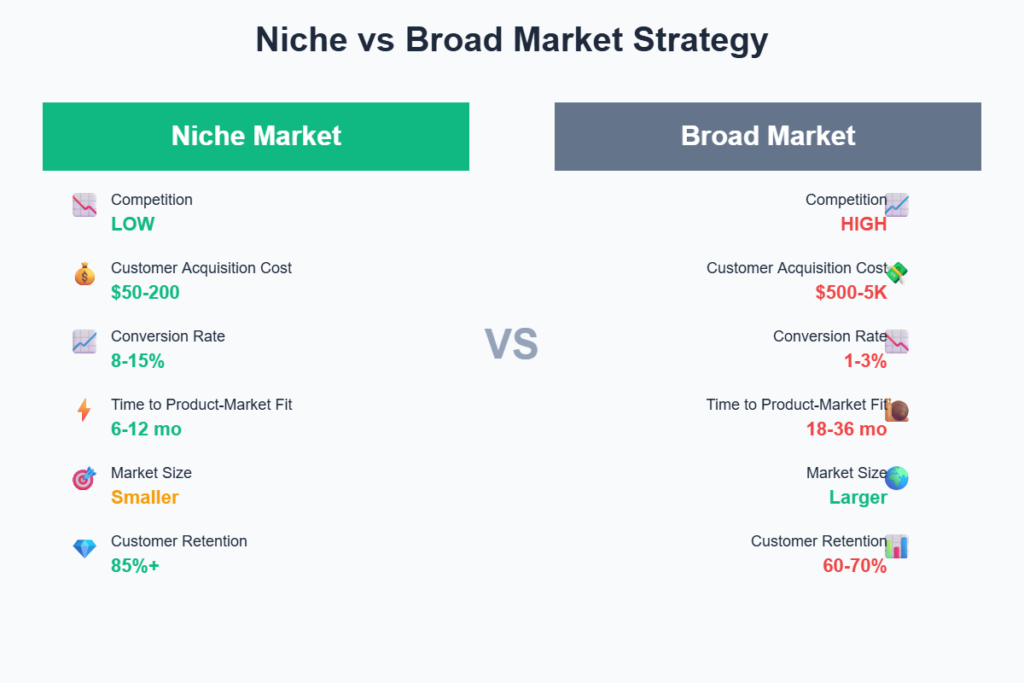
The Competitive Advantage of Going Niche
While major players fight over saturated markets like general customer support or basic analytics, underserved small markets for ai saas ideas offer several distinct advantages:
Reduced Marketing Costs: When you target a specific niche, your marketing becomes laser-focused. Instead of competing for expensive generic keywords, you can dominate long-tail searches with lower CPCs and higher intent.
Faster Product-Market Fit: Smaller markets mean more direct access to your target users. You can iterate quickly based on feedback from a tightly-defined audience, avoiding the paralysis that comes from trying to serve everyone.
Community-Driven Growth: Niche markets often have tight-knit communities. When you solve a real problem, word spreads quickly through industry-specific forums, Slack groups, and professional networks.
Higher Willingness to Pay: Businesses in underserved markets understand the pain of poor solutions. They’re often willing to pay premium prices for tools specifically built for their needs rather than settling for generic alternatives that require workarounds.
The 2026 Market Dynamics
The AI SaaS landscape has shifted dramatically. According to Gartner’s latest research, vertical-specific AI solutions are projected to grow at 42% CAGR through 2028, significantly outpacing horizontal platforms at 23%. This trend reflects a fundamental market maturation: businesses now want precision over versatility.
Additionally, the democratization of AI development through accessible APIs, pre-trained models, and no-code platforms means that small teams can now build sophisticated solutions for specialized markets—something that previously required massive engineering resources.
13 Small Underserved Markets for AI SaaS Ideas in 2026
Let’s dive into specific niche ai saas ideas for small underserved markets that represent genuine opportunities in 2026. Each of these markets has demonstrated pain points, willingness to pay, and limited existing solutions.
![13 Underserved AI SaaS Market Opportunities featuring:
- Funeral Home Management – AI grief support & scheduling ($2.3B market, low competition)
- Independent Pharmacy Ops – Inventory & compliance automation (19,000+ pharmacies)
- Pet Grooming Salons – Smart booking & client management (125,000+ businesses)
- Mobile Food Truck Operations – Route optimization & menu pricing (35,000+ trucks)
- Craft Brewery Management – Recipe optimization & batch tracking (9,000+ breweries)
- Speech Therapy Practices – Progress tracking & exercise personalization (15,000+ practices)
- Daycare Centers – Child development tracking & parent comms (100,000+ centers)
- Home Inspection Services – Photo analysis & report generation (50,000+ inspectors)
- Rural Agricultural Co-ops – Yield prediction & resource allocation (2,000+ co-ops)
- Escape Room Businesses – Dynamic puzzle generation (2,300+ locations)
- Court Reporting Services – Transcript summarization (5,000+ firms)
- Wedding Videographers – Auto highlight generation (45,000+ professionals)
- Dock & Marina Management – Slip booking & maintenance (12,000+ marinas)]
1. AI-Powered Funeral Home Management Platform
Market Size: $2.3 billion industry with 19,000+ funeral homes in the US alone
The Opportunity: Funeral homes operate with deeply personal, emotionally sensitive processes that still rely heavily on manual paperwork, phone calls, and disconnected systems. This is one of the most underserved niche markets for ai saas ideas where compassionate technology can make a genuine difference.
Key Features:
- Grief-Aware Communication AI: Automated yet empathetic email and text communications that adjust tone based on context
- Service Planning Assistant: AI that helps families make decisions by understanding preferences and budget constraints
- Compliance Documentation: Automatic generation of required state and federal forms
- Memorial Content Generator: Creates personalized obituaries, tribute videos, and memorial website content from family interviews
Why It’s Underserved: Most funeral homes use software built in the early 2000s or rely on paper systems. The industry is relationship-driven and hesitant to adopt cold technology—but AI that enhances rather than replaces human compassion fills a clear gap.
Revenue Model: $200-500/month per location, with premium tiers for multi-location operations. Average customer lifetime value: $18,000+
2. Independent Pharmacy Operations Intelligence
Market Size: 19,200 independent pharmacies representing $81 billion in annual revenue
The Opportunity: While chain pharmacies have enterprise systems, independent pharmacies struggle with inventory management, insurance billing complexity, and regulatory compliance—all perfect applications for AI automation.
Key Features:
- Predictive Inventory Management: AI forecasts medication needs based on local prescription trends, seasonal patterns, and demographic shifts
- Insurance Claim Optimization: Automatically identifies claim rejection patterns and suggests corrections before submission
- Drug Interaction Alerts: Real-time AI analysis of prescription combinations with patient history integration
- Compounding Recipe Assistant: Helps pharmacies create custom medication formulations with precise calculations
Why It’s Underserved: Most pharmacy software focuses on chains. Independent pharmacies need specialized tools that address their unique challenges: smaller budgets, diverse customer bases, and local regulatory variations.
Revenue Model: $300-600/month based on prescription volume, plus per-transaction fees for claim optimization. Upsell opportunities with patient engagement modules.
3. Smart Management Platform for Pet Grooming Salons
Market Size: 125,000+ pet grooming businesses in the US, with 67% growth since 2020
The Opportunity: The pet care industry is booming, but most grooming salons use basic appointment software that doesn’t address their specific operational challenges. This represents prime territory among ideas for ai saas in small underserved markets.
Key Features:
- Breed-Specific Scheduling: AI optimizes appointment lengths based on breed, coat condition, and service history
- Behavior Prediction: Analyzes past appointment notes to flag pets that may need special handling or extended times
- Photo-Based Progress Tracking: Computer vision compares before/after photos and generates shareable client updates
- Smart Reminder System: Sends personalized rebooking prompts based on breed grooming schedules and seasonal patterns
Why It’s Underserved: Generic booking systems don’t understand the nuances of pet grooming—the difference between a Poodle and a Golden Retriever appointment, seasonal shedding patterns, or behavior management.
Revenue Model: $89-199/month tiered by number of groomers. Additional revenue from SMS marketing add-ons and photo storage.
4. Mobile Food Truck Route & Revenue Optimization
Market Size: 35,000+ food trucks generating $1.2 billion annually
The Opportunity: Food truck operators face unique challenges: choosing profitable locations, dynamic menu pricing, managing inventory in confined spaces, and adapting to weather and events. Traditional restaurant software doesn’t address mobile operations.
Key Features:
- AI Route Optimization: Predicts best locations based on weather, events, foot traffic data, and historical sales
- Dynamic Menu Pricing: Adjusts prices in real-time based on ingredient costs, demand, and competitor proximity
- Inventory Forecasting: Predicts ingredient needs for specific routes and events to minimize waste
- Event Opportunity Finder: Scans local events, permits, and competitor activity to suggest profitable opportunities
Why It’s Underserved: Food trucks operate at the intersection of restaurant, retail, and logistics—requiring specialized software that doesn’t exist in one platform.
Revenue Model: $99-249/month per truck, with enterprise pricing for fleet operators. Commission-based model for high-value event bookings.
5. Craft Brewery Production & Distribution Intelligence
Market Size: 9,600+ craft breweries with consistent year-over-year growth
The Opportunity: Craft breweries balance artistry with complex operational challenges: recipe consistency, batch tracking, distribution logistics, and regulatory compliance. Most use spreadsheets or generic manufacturing software.
Key Features:
- Recipe Optimization AI: Suggests adjustments based on ingredient availability, cost, and consistency goals
- Quality Control Automation: Analyzes testing data to predict batch issues before they occur
- Distribution Route Planning: Optimizes delivery routes considering product freshness windows and customer preferences
- Compliance Documentation: Automatically generates TTB reports and state-specific regulatory paperwork
Why It’s Underserved: Brewery-specific software exists but lacks AI capabilities. Generic manufacturing tools don’t understand the craft brewing process or regulatory environment.
Revenue Model: $299-799/month based on production volume. Additional modules for taproom management and retail distribution.
6. Speech Therapy Practice Management with Progress AI
Market Size: 15,000+ private speech therapy practices treating millions of patients
The Opportunity: Speech therapists spend hours documenting sessions, tracking patient progress, and creating personalized exercises. AI can transform both clinical outcomes and administrative efficiency in this niche underserved market for ai saas ideas.
Key Features:
- Voice-Powered Session Notes: Transcribes therapy sessions with automatic SOAP note generation
- Progress Prediction Models: Analyzes patient data to forecast improvement timelines and adjust treatment plans
- Exercise Personalization Engine: Generates customized home practice activities based on patient age, goals, and progress
- Insurance Authorization Assistant: Predicts authorization likelihood and auto-generates supporting documentation
Why It’s Underserved: Speech therapy software focuses on scheduling and billing, not clinical intelligence. Therapists need AI that understands phonological processes, articulation patterns, and treatment protocols.
Revenue Model: $149-399/month per therapist, with family engagement portal as premium add-on. Insurance billing optimization on percentage basis.
7. AI-Enhanced Daycare Center Operations
Market Size: 100,000+ licensed childcare centers serving 8+ million children
The Opportunity: Daycare centers juggle child safety, developmental tracking, parent communication, staff scheduling, and complex compliance requirements—mostly using outdated software or paper systems.
Key Features:
- Developmental Milestone Tracking: AI analyzes daily observations to flag potential delays and suggest activities
- Photo-Based Daily Reports: Computer vision automatically generates parent updates from facility photos
- Staff-to-Child Ratio Optimizer: Predicts daily attendance and automatically schedules appropriate staffing
- Compliance Checklist Automation: Tracks state licensing requirements and generates audit-ready documentation
Why It’s Underserved: Existing daycare software handles billing and check-in/out but ignores the educational and developmental aspects that differentiate quality centers.
Revenue Model: $199-499/month based on enrollment capacity. Premium tiers include parent mobile app and developmental curriculum library.
8. Computer Vision Platform for Home Inspectors
Market Size: 50,000+ certified home inspectors conducting 7+ million inspections annually
The Opportunity: Home inspectors take hundreds of photos per job, then spend hours manually sorting, annotating, and incorporating them into reports. This manual process is ripe for AI transformation.
Key Features:
- Automated Issue Detection: Computer vision identifies potential problems in photos (foundation cracks, roof damage, electrical issues)
- Intelligent Photo Organization: AI categorizes and labels inspection photos by room and system
- Report Generation Assistant: Creates narrative reports with properly positioned photos and descriptions
- Historical Comparison: Analyzes photos from previous inspections to identify changes over time
Why It’s Underserved: Home inspection software focuses on templates and checklists, not AI-powered image analysis. Inspectors spend 40% of their time on reporting—a huge efficiency opportunity.
Revenue Model: $129-299/month per inspector. Additional revenue from white-label reports for real estate agencies.
9. Agricultural Co-op Resource Allocation Intelligence
Market Size: 2,000+ agricultural cooperatives serving 2 million farmers
The Opportunity: Rural agricultural co-ops coordinate equipment sharing, bulk purchasing, and resource allocation among member farmers. They use spreadsheets and phone calls for complex logistics that AI could optimize.
Key Features:
- Equipment Scheduling Optimizer: AI coordinates shared machinery usage based on crop cycles, weather, and member priorities
- Yield Prediction Models: Combines weather data, soil conditions, and historical performance to forecast harvest volumes
- Bulk Purchase Optimization: Analyzes member needs to time seed, fertilizer, and chemical purchases for best pricing
- Grant Application Assistant: Identifies relevant USDA programs and auto-populates application forms
Why It’s Underserved: Agricultural technology focuses on individual farms, not cooperative structures. Co-ops have unique needs around member coordination and shared resources.
Revenue Model: $500-1,500/month based on member count, plus implementation fees. Percentage of savings on bulk purchases.
10. Dynamic Experience Engine for Escape Rooms
Market Size: 2,300+ escape room locations in a rapidly growing experience economy
The Opportunity: Escape room operators face a constant challenge: creating fresh puzzles and experiences while managing costs. Once customers complete a room, they rarely return. AI can enable dynamic, personalized experiences.
Key Features:
- Adaptive Puzzle Generator: Creates variations of existing rooms so repeat customers face different challenges
- Difficulty Calibration AI: Adjusts hint timing and puzzle complexity based on team performance in real-time
- Story Personalization: Tailors narrative elements to group demographics and preferences
- Performance Analytics: Provides operators with insights on puzzle effectiveness and customer engagement
Why It’s Underserved: Escape room operators use basic booking systems. No one offers AI-powered experience personalization for this growing market.
Revenue Model: $199-399/month per location, with variable pricing for multi-location operators. Revenue share on dynamic content licensing.
11. Legal Transcript Intelligence for Court Reporting Services
Market Size: 5,000+ court reporting firms processing millions of pages annually
The Opportunity: Court reporters produce verbatim transcripts but often need to create summaries, identify key moments, and extract exhibits—all manual processes that AI can accelerate.
Key Features:
- Intelligent Summarization: Creates executive summaries of depositions highlighting key testimony
- Speaker Identification: Automatically labels speakers and creates speaker-specific timelines
- Exhibit Correlation: Links transcript references to physical/digital exhibits automatically
- Precedent Finder: Identifies similar past cases based on testimony content
Why It’s Underserved: Legal technology focuses on document management and case law research, not transcript intelligence. Court reporters need specialized AI for their unique workflow.
Revenue Model: Per-page processing fees ($0.50-1.50) or monthly subscription ($299-799) based on volume. White-label services for law firms.
12. AI Video Editor for Wedding Videographers
Market Size: 45,000+ professional wedding videographers plus thousands of part-time operators
The Opportunity: Wedding videographers spend 20-30 hours editing each wedding. AI can identify highlights, sync multi-camera footage, and create rough cuts—allowing videographers to serve more clients.
Key Features:
- Highlight Detection: AI identifies key moments (kiss, first dance, toasts) across hours of footage
- Emotional Scene Recognition: Scores footage segments by emotional intensity to prioritize editing
- Multi-Camera Sync: Automatically aligns footage from multiple cameras and devices
- Music Matching: Suggests beat-aligned edit points based on selected soundtrack
Why It’s Underserved: Video editing software offers raw tools but no wedding-specific AI intelligence. Videographers in this underserved small market for ai saas ideas need automated assistance for repetitive tasks.
Revenue Model: Credit-based system ($29-99/month) or per-project pricing ($15-40 per wedding). Premium tier with music licensing included.
13. Marina & Dock Slip Management Platform
Market Size: 12,000+ marinas managing 875,000+ boat slips
The Opportunity: Marinas handle seasonal slip rentals, transient dockage, maintenance scheduling, and regulatory compliance with minimal software support. They need intelligent systems for complex logistics.
Key Features:
- Dynamic Slip Pricing: AI adjusts rates based on demand, seasonality, boat size, and amenity preferences
- Predictive Maintenance Scheduling: Forecasts dock repair needs based on weather, usage, and inspection data
- Transient Booking Optimization: Maximizes revenue from short-term dockage by predicting demand patterns
- Winter Storage Logistics: Optimizes boat storage yard layouts and haul-out scheduling
Why It’s Underserved: Marinas use outdated property management systems not built for nautical operations. The industry lacks modern, maritime-specific technology.
Revenue Model: $249-799/month based on slip count. Additional revenue from online booking integration and boat owner mobile app.
How to Identify More Underserved Markets for Your AI SaaS
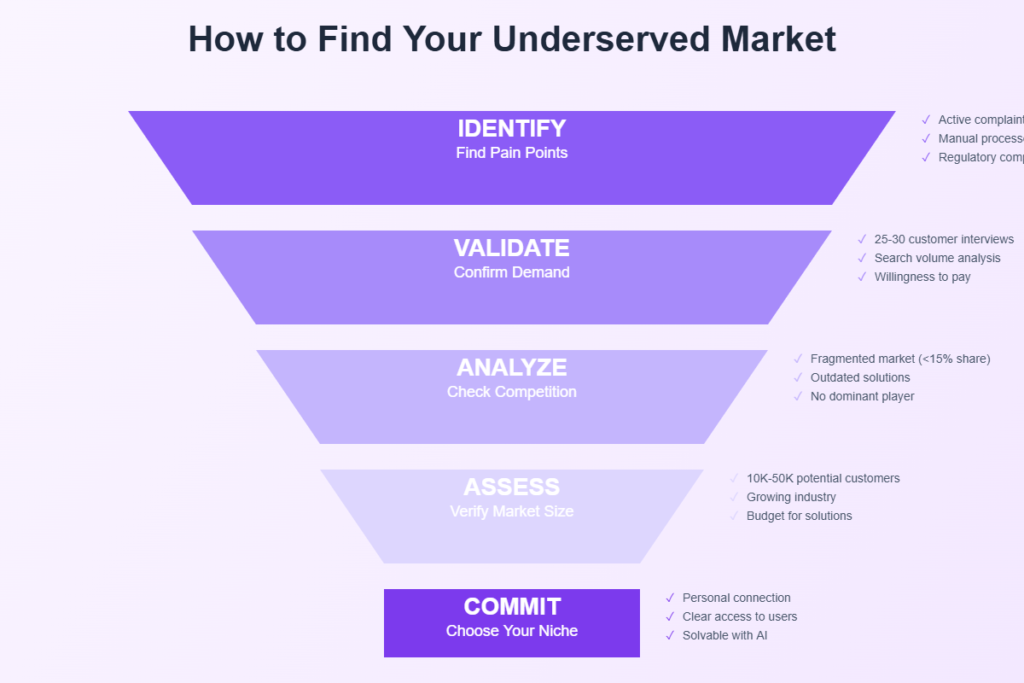
Beyond these specific ai saas ideas for small underserved markets 2026, you can develop a systematic approach to finding untapped opportunities:
The Pain-to-Solution Gap Analysis
Look for industries where:
- High Pain Exists: Operators regularly complain about specific manual processes or inefficiencies
- Low Software Adoption: Less than 30% of the market uses modern software solutions
- Fragmented Market: No dominant player controls more than 15% market share
- Regulatory Complexity: Compliance requirements create barriers that AI can help overcome
- Professional Communities: Active forums, associations, or Facebook groups where practitioners share problems
The Local-to-Digital Transition Test
Many underserved markets are businesses transitioning from local, relationship-based operations to digital processes:
- Service businesses (plumbers, electricians, locksmiths) adopting online booking
- Brick-and-mortar retail (comic book stores, hobby shops) building e-commerce presence
- Traditional trades (welding shops, machine shops) implementing work order management
- Community organizations (youth sports leagues, community theaters) digitizing operations
These businesses understand their pain points but lack technical expertise to evaluate solutions—creating opportunities for purpose-built AI tools.
The Specialist vs. Generalist Indicator
If an industry currently uses generic tools (Excel, Google Sheets, basic CRMs) for highly specialized workflows, there’s likely an opportunity. Ask:
- Are there industry-specific terms, processes, or regulations not reflected in existing software?
- Do practitioners regularly customize generic tools with complex workarounds?
- Would a specialist solution command premium pricing over generic alternatives?
Critical Success Factors for Niche AI SaaS in 2026
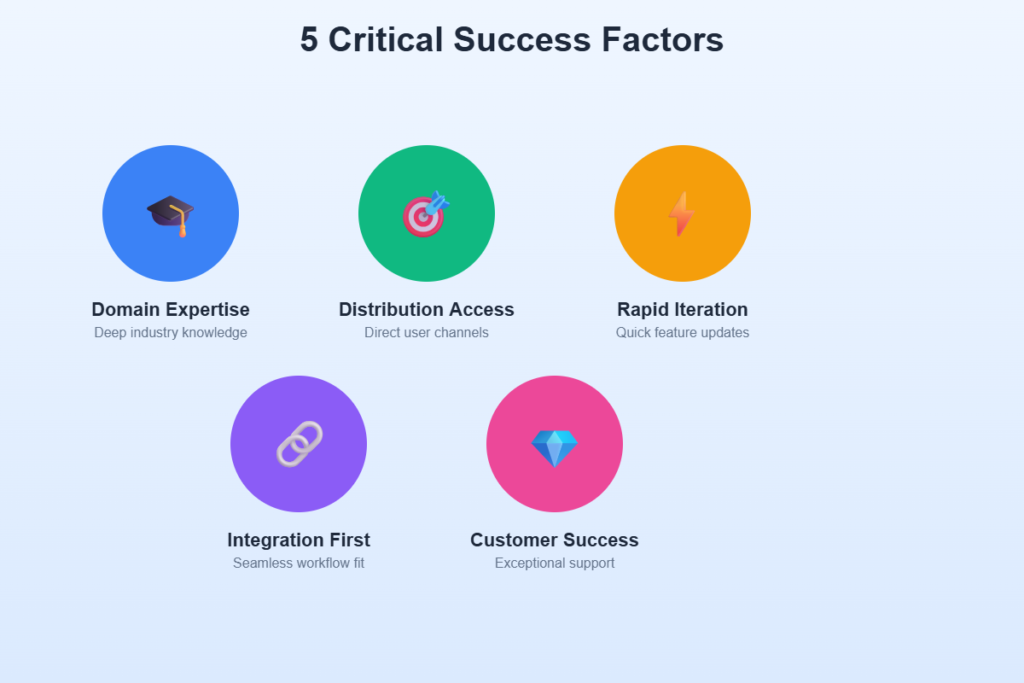
5 Critical Success Factors:
1. Deep Domain Expertise Understand industry workflows, terminology, and pain points at a practitioner level. Attend conferences, join communities, and interview target users extensively.
2. Distribution Channel Access Identify where your target users congregate: trade shows, industry publications, professional associations, Facebook groups, or niche forums. Build relationships there first.
3. Rapid Iteration Capability Niche markets demand specialized features. Build infrastructure for quick iteration based on user feedback. Your competitive advantage is speed and customization.
4. Integration-First Approach Niche users already have established workflows. Integrate with existing tools (QuickBooks, industry-specific software) rather than demanding complete replacement.
5. Customer Success Obsession In small markets, reputation spreads quickly. Provide exceptional support and become a trusted partner, not just a vendor.
1. Build Deep Domain Expertise
You don’t need to be an industry insider from day one, but you absolutely need to become one. This means:
Immersive Research: Spend weeks (not days) understanding the industry. Shadow practitioners, read trade publications, join industry Facebook groups and forums. For a funeral home platform, this might mean attending mortuary science conferences or working part-time at a funeral home.
Language Mastery: Every industry has specialized vocabulary. For speech therapy, understand terms like “phonological processes” and “apraxia.” For marinas, know the difference between “transient dockage” and “seasonal slip rental.” Using correct terminology builds immediate credibility.
Workflow Documentation: Create detailed workflow diagrams before writing any code. Understand not just what users do, but why they do it that way, what regulations require it, and where pain points occur.
2. Identify and Penetrate Distribution Channels
Finding users in niche markets requires different strategies than broad consumer software:
Industry Associations: Most specialized industries have professional organizations. Becoming a sponsor or exhibitor at their conferences provides direct access to decision-makers. For example, the National Funeral Directors Association annual conference draws 10,000+ attendees—exactly your target market.
Trade Publications: Industries have specialized magazines and websites. A well-placed article or advertisement in Pet Grooming Professional reaches your exact audience better than Google Ads.
Community Partnerships: Partner with industry influencers, consultants, or training organizations who already have trust and attention. A speech therapy platform partnering with continuing education providers gets built-in distribution.
Vertical-Specific SEO: Optimize for highly specific long-tail keywords that your target users actually search. “Best funeral home management software” beats “business management software” for reach to decision-makers.
3. Embrace Rapid Iteration Based on User Feedback
Niche markets offer a superpower: direct access to your entire addressable market. Use it:
Beta Communities: Recruit 5-10 early adopters for intensive feedback. Offer free or heavily discounted access in exchange for weekly calls and feature input.
Feature Prioritization: In niche markets, users will explicitly tell you what they need. Build a public roadmap and let customers vote on priorities.
Specialized Customization: Be willing to build customer-specific features that you can later generalize. Your first funeral home client might need Michigan-specific compliance features that you can expand to all 50 states.
4. Integration-First Product Strategy
Niche market users won’t abandon working systems for your product. You need to fit into their existing ecosystem:
Essential Integrations:
- Accounting software (QuickBooks, Xero) for financial data
- Industry-specific platforms (practice management systems, POS, etc.)
- Communication tools (email, SMS, phone systems)
- Payment processors specific to the industry
API-First Architecture: Build your product with integration capabilities from day one. Niche users often have unique combinations of tools, and flexibility is a competitive advantage.
5. Exceptional Customer Success Creates Network Effects
In small markets, your reputation is everything. One unhappy customer can damage your brand across 10% of your addressable market:
Proactive Support: Don’t wait for users to struggle. Monitor usage patterns and reach out when you see confusion or underutilization.
Industry-Specific Training: Create training materials that use industry terminology and realistic scenarios. A generic “how to use our software” video won’t resonate like a “how to schedule grooming appointments during holiday season rushes” tutorial.
Community Building: Create user communities where practitioners can share best practices. For a daycare management platform, facilitate sharing of activity plans and teaching strategies.
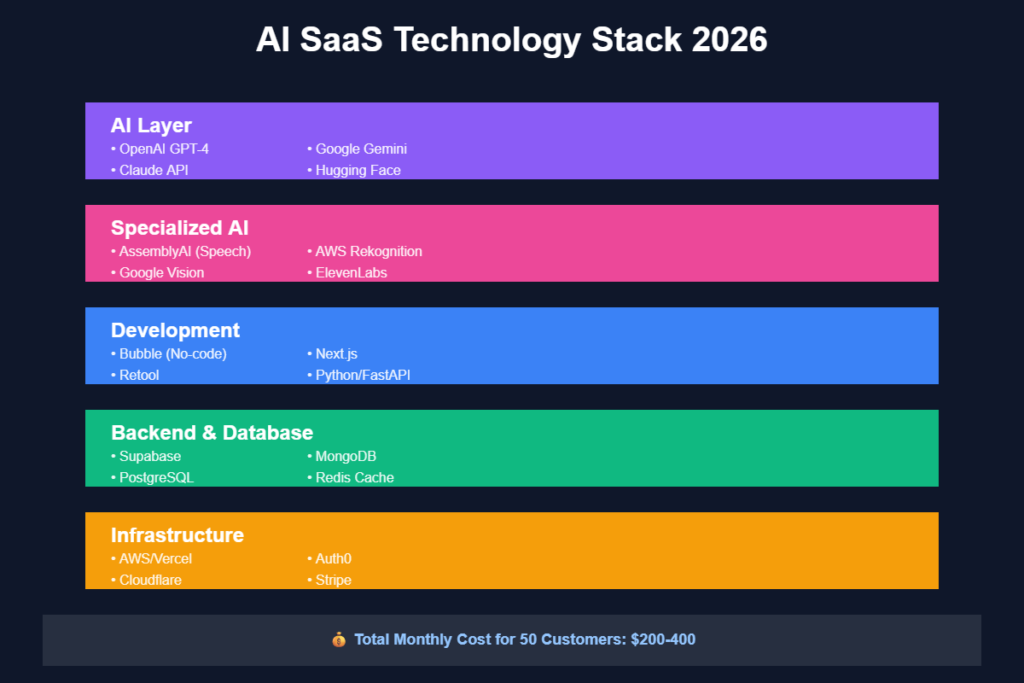
Technology Enablers Making Niche AI SaaS Accessible in 2026
The barrier to entry for ai saas ideas for small underserved markets has never been lower thanks to these technological developments:
Pre-Trained Foundation Models
You don’t need to train AI models from scratch. Services like OpenAI’s GPT-4, Anthropic’s Claude, and Google’s Gemini provide powerful capabilities through simple API calls:
- Text generation for creating reports, communications, and content
- Classification for categorizing documents, images, or customer inquiries
- Extraction for pulling structured data from unstructured sources
- Translation for multilingual support in diverse markets
Cost Impact: What once required $500K+ in ML engineering now costs $100-500/month in API fees for early-stage products.
No-Code/Low-Code AI Platforms
Tools like Zapier, Make, Bubble, and Retool allow non-technical founders to build sophisticated AI workflows:
- Connect API endpoints without writing backend code
- Build responsive frontend interfaces with drag-and-drop builders
- Orchestrate complex multi-step AI processes visually
- Test and iterate without full development cycles
Time Impact: MVP development time has dropped from 6-12 months to 4-8 weeks for experienced no-code builders.
Specialized AI Services
Beyond general-purpose models, specialized services handle complex tasks:
- Computer Vision APIs (Google Vision, AWS Rekognition) for image analysis in home inspections or pet grooming
- Speech Recognition (AssemblyAI, Deepgram) for court reporting or therapy session transcription
- Document Understanding (Azure Form Recognizer) for parsing insurance forms or compliance documents
- Voice Synthesis (ElevenLabs, Play.ht) for creating audio content or voice assistants
Cloud Infrastructure-as-a-Service
Modern cloud platforms provide enterprise-grade infrastructure at startup-friendly prices:
- Serverless computing (AWS Lambda, Google Cloud Functions) eliminates infrastructure management
- Managed databases (Supabase, PlanetScale) handle scaling and backups automatically
- CDN services (Cloudflare, Fastly) ensure fast global delivery
- Authentication platforms (Auth0, Clerk) handle user security
Example Cost Structure: A niche AI SaaS serving 50 customers might run on $200-400/month in infrastructure—a cost structure that enables profitable bootstrapping.
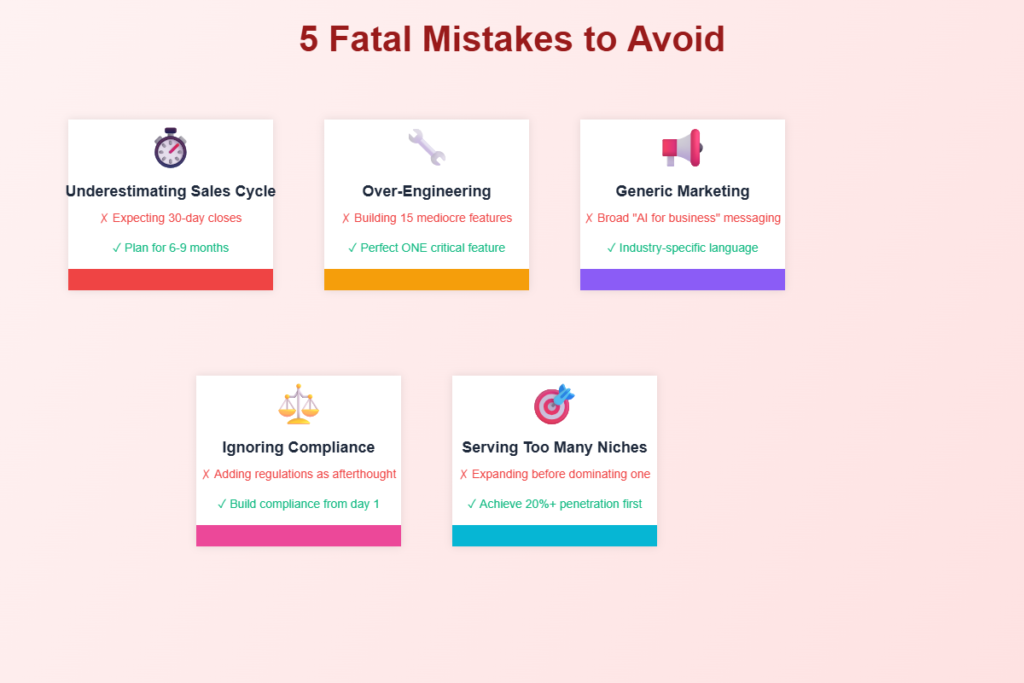
Common Pitfalls to Avoid When Targeting Underserved Markets
1. Underestimating Sales Cycle Length
Small business decision-makers are busy running operations. They don’t have procurement departments or rapid IT adoption processes. A funeral home director might take 6-9 months from initial interest to purchase.
Solution: Build cash runway accordingly and create low-friction trial experiences. Offer 30-60 day free trials rather than demos. Let the product sell itself through daily use.
2. Over-Engineering the Initial Product
The temptation with AI is to build sophisticated features that showcase technical prowess. But niche users care about solving specific pain points, not impressive technology.
Solution: Identify the single most painful manual process and automate it extremely well. A pharmacy inventory system that only predicts reorder points but does it flawlessly is more valuable than a complex system with 15 mediocre features.
3. Generic Marketing and Positioning
Using broad language like “AI-powered business intelligence” won’t resonate with niche audiences. They need to immediately recognize that the product was built specifically for them.
Solution: Use industry-specific language in all marketing. Your homepage headline should mention the specific industry: “The AI Platform Built Specifically for Independent Pharmacies” not “AI for Healthcare Businesses.”
4. Ignoring Regulatory and Compliance Requirements
Many underserved markets have strict regulations (healthcare privacy, financial reporting, licensing requirements). Overlooking these creates deal-breaking obstacles.
Solution: Research compliance requirements before building. For healthcare-related niches, factor in HIPAA compliance from day one. For financial services, understand audit trail requirements. Build these into your core architecture, not as afterthoughts.
5. Attempting to Serve Too Many Niches Simultaneously
Once you’ve built one niche product, it’s tempting to quickly expand to adjacent markets. This dilutes focus and slows growth.
Solution: Dominate one niche completely before expanding. Achieve 20%+ market penetration in your initial target market. This creates a reference base and case studies that make expansion easier.
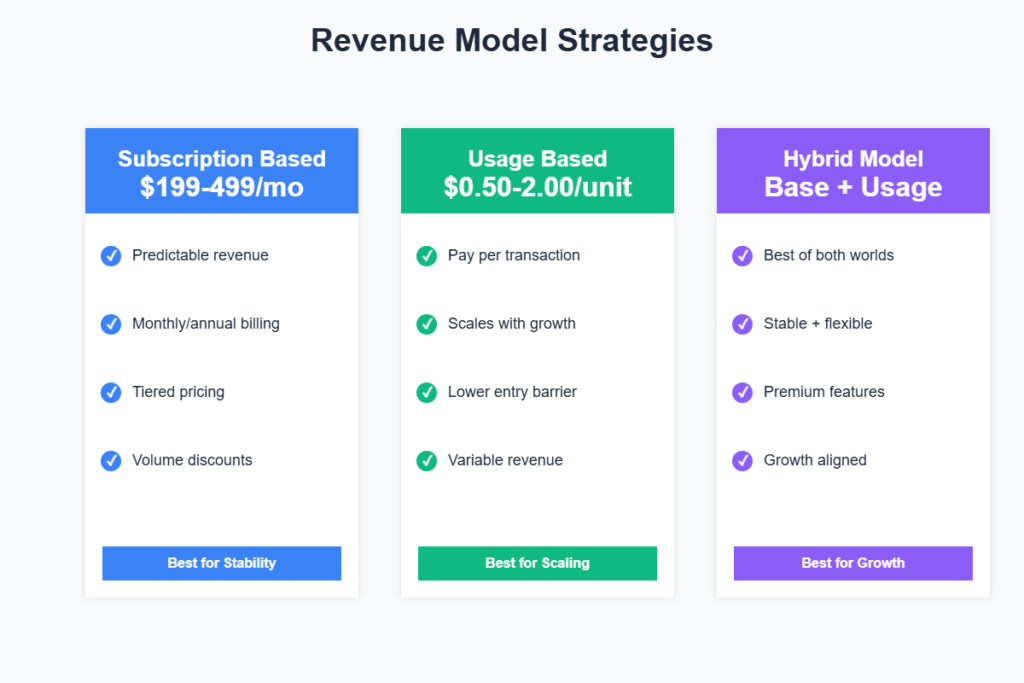
Pricing Strategies for Niche AI SaaS Products
Niche markets allow for different pricing approaches than mass-market products:
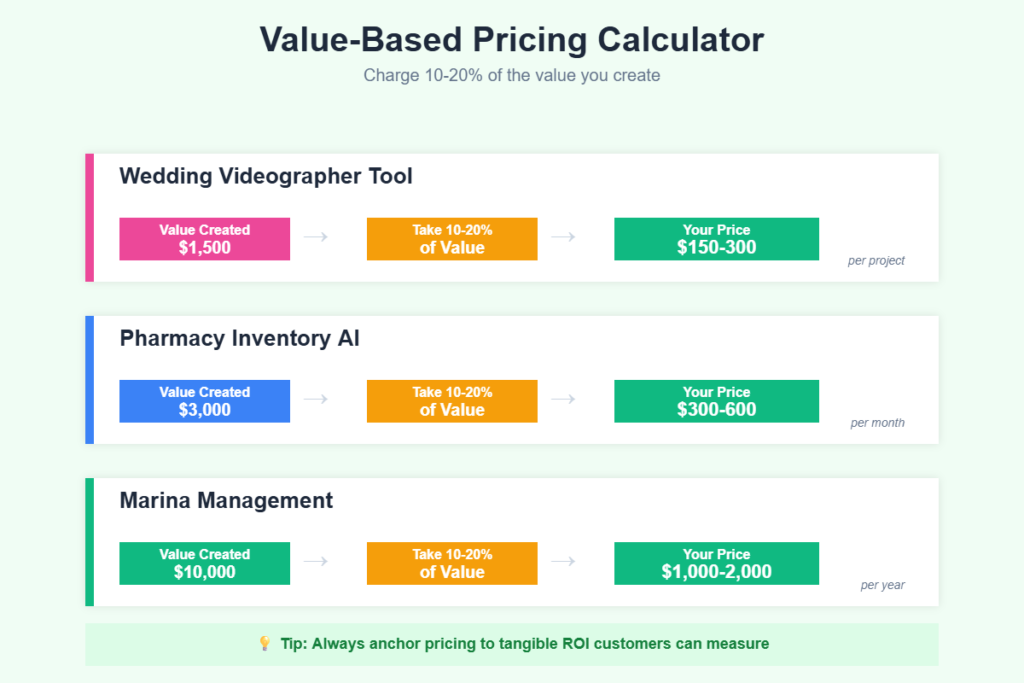
Value-Based Pricing
Calculate the tangible value your AI creates:
- Time savings: If your tool saves a wedding videographer 20 hours per project at $75/hour, that’s $1,500 in value per wedding
- Revenue increase: If dynamic pricing for marinas increases slip revenue by $10,000/year, that’s measurable value
- Cost reduction: If pharmacy inventory optimization reduces waste by $3,000/month, that’s quantifiable savings
Pricing Rule: Charge 10-20% of the value created. This ensures compelling ROI while capturing fair value.
Tiered Pricing by Business Size
Structure tiers based on business metrics that correlate with value:
Example – Pet Grooming Platform:
- Solo Groomer: $89/month (1 stylist, 100 appointments/month)
- Small Salon: $149/month (2-3 stylists, 300 appointments/month)
- Multi-Location: $299/month per location (4+ stylists, unlimited appointments)
Usage-Based Components
Add variable pricing for consumption-based features:
- Per-transaction fees for payment processing or insurance claims
- Per-analysis costs for AI-intensive features (video analysis, complex predictions)
- Storage fees for photo libraries or document archives
Balance: Keep base subscription high enough for predictable revenue, but add usage components to align pricing with customer growth.
Annual Contracts with Discounts
Small businesses appreciate predictability. Offer 15-20% discounts for annual prepayment to improve cash flow and reduce churn.
Growth Strategies Beyond Your Initial Niche
Once you’ve established dominance in one underserved niche market for ai saas ideas, strategic expansion amplifies returns:
Horizontal Expansion (Adjacent Niches)
Leverage your technology to serve related markets:
Example Path: Funeral Home Platform → Memorial Services → Cemetery Management → Estate Planning Services
Each adjacent market shares technology components but serves distinct customer segments, allowing you to build upon existing capabilities.
Vertical Integration (Ecosystem Expansion)
Add complementary services for your existing customer base:
Example Path: Pharmacy Inventory → Patient Engagement → Insurance Billing → Telepharmacy Services
This increases average revenue per customer and deepens switching costs.
Geographic Expansion
Many niche markets have regional variations:
- Start in one state or country with specific regulatory knowledge
- Expand to similar regulatory environments
- Build country-specific compliance modules over time
Example: A daycare platform might start in California (strict regulations, tech-friendly), expand to New York and Massachusetts (similar regulatory frameworks), then tackle Texas and Florida (different requirements).
Platform Strategy (Long-term)
After dominating 3-4 related niches, consider a platform approach:
- Open APIs for third-party integrations
- White-label offerings for industry consultants
- Marketplace for industry-specific add-ons
- Training and certification programs
This transforms you from a software vendor to an industry platform—the ultimate defensible position.
Case Study: How One Founder Built a $2M ARR Niche AI SaaS
The Opportunity: The founder, a former physical therapist, noticed therapy clinics struggled with documentation, spending 2-3 hours daily on insurance paperwork and patient notes.
Initial Market Research:
- Surveyed 100 clinics about documentation pain points
- Shadowed 5 therapists for full days to understand workflows
- Analyzed insurance claim denial patterns across 20,000 claims
MVP Development (12 weeks):
- Built voice-to-text dictation specifically trained on therapy terminology
- Created templates for common treatment plans and progress notes
- Integrated with top 3 EMR systems used by independent clinics
Go-to-Market Strategy:
- Attended the American Physical Therapy Association conference
- Published articles in PT magazines about documentation efficiency
- Recruited 10 beta clinics offering 90-day free trials
Results (18 months):
- 187 paying clinics at $299/month average
- $67,000 monthly recurring revenue
- 94% customer retention rate
- 60% of new customers from word-of-mouth referrals
Key Success Factors:
- Deep domain expertise from personal industry experience
- Solving one critical problem exceptionally well (documentation)
- Strategic distribution through industry events and publications
- Obsessive customer success leading to organic growth
Expansion Path:
- Added modules for occupational therapy (adjacent market)
- Launched patient home exercise library (vertical integration)
- Currently expanding to speech therapy (related clinical niche)
This case study illustrates how focusing intensely on a small underserved market creates rapid traction and sustainable growth.
Frequently Asked Questions About Underserved AI SaaS Markets
How do I validate an underserved market before building?
Start with customer development interviews. Speak with 20-30 potential users in your target niche. Ask about their current tools, manual processes, biggest time sinks, and willingness to pay for solutions. If 70%+ express strong interest and clear pain points, you’ve found validation.
Additionally, check these signals:
- Active complaints in industry forums and groups
- High search volume for industry-specific software (use tools like Ahrefs or SEMrush)
- Fragmented competitive landscape with no dominant player
- Recent regulatory changes creating new compliance burdens
What’s the minimum viable market size for a sustainable AI SaaS business?
A market with 10,000-50,000 potential customers can support a thriving business. At 5% market penetration with $200/month average revenue, that’s $100,000-500,000 in monthly recurring revenue—enough for a sustainable, profitable business. Many founders overestimate the market size needed for success.
How long does it typically take to achieve product-market fit in a niche?
Niche markets often reach product-market fit faster than broad markets—typically 6-12 months versus 18-24 months for horizontal products. The tight feedback loops and specific use cases accelerate iteration. You’ll know you’ve achieved fit when customers start referring others without prompting and your churn rate drops below 5% monthly.
Should I build industry-specific features or keep the product more general?
Always prioritize industry-specific features for niche markets. Generic flexibility is a weakness, not a strength. Specialized features, terminology, and workflows demonstrate that you understand the market deeply. This justifies premium pricing and creates switching costs.
How do I compete if a larger company enters my niche?
Niche focus is your competitive moat. Larger companies struggle with:
- Understanding nuanced industry workflows
- Justifying development resources for small markets
- Providing specialized customer support
- Moving quickly on feature requests
Maintain your advantage through deep relationships, rapid iteration, and industry-specific excellence that generalist competitors can’t match.
What’s the best pricing model for niche AI SaaS products?
Subscription-based pricing with annual discounts works best. This provides predictable revenue while aligning with small business budgets. Add usage-based components for features with variable costs (AI processing, storage, transactions). Avoid purely usage-based pricing as it creates revenue unpredictability and customer anxiety about costs.
How much should I invest in AI capabilities versus basic software features?
Start with AI for the most painful manual processes (80% of value creation), then add essential software features (20% of functionality). For example, a court reporting platform should prioritize AI summarization over fancy scheduling interfaces. Once the AI delivers clear value, expand operational features based on user feedback.
Can I bootstrap a niche AI SaaS or do I need venture funding?
Many niche AI SaaS companies successfully bootstrap. Lower infrastructure costs (thanks to cloud services and AI APIs), focused markets requiring less marketing spend, and faster customer acquisition cycles make this viable. Venture funding makes sense if you’re pursuing aggressive multi-niche expansion or building complex proprietary AI models.
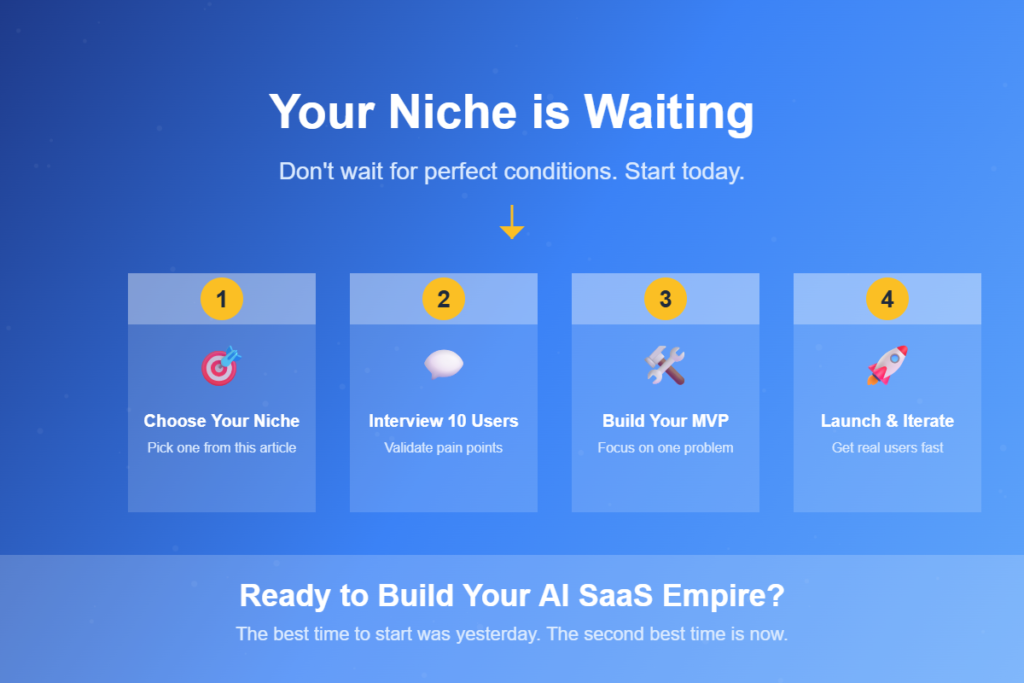
Taking Action: Your Next Steps
90-Day Launch Roadmap for Niche AI SaaS
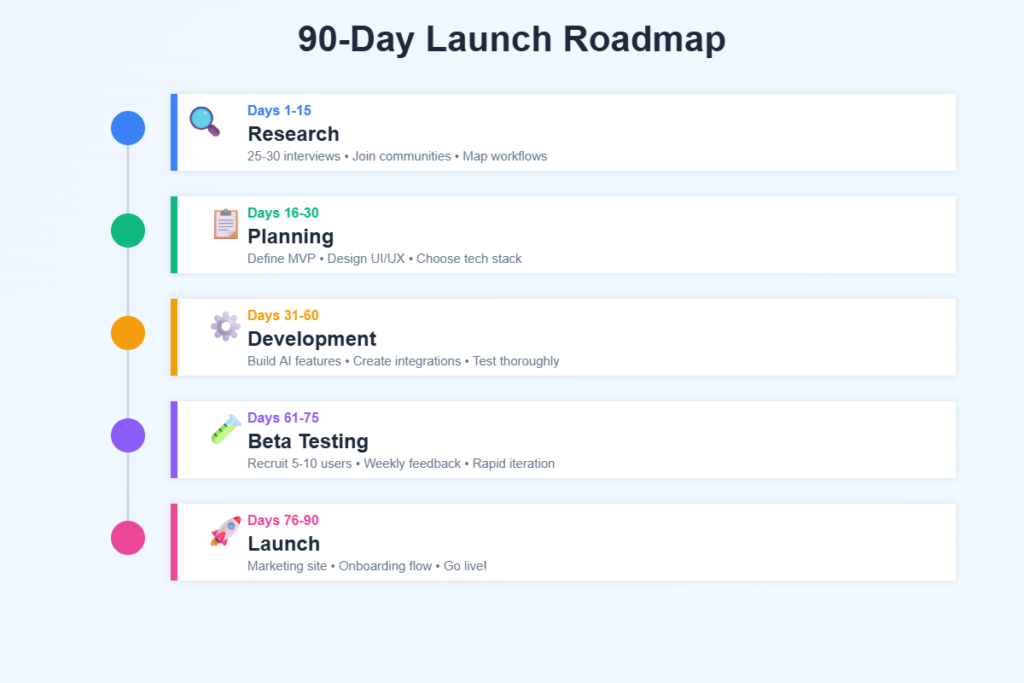
Days 1-15: Market Research & Validation ✓ Interview 25-30 potential customers in target niche ✓ Join industry forums, Facebook groups, and associations ✓ Document workflows, pain points, and existing tool limitations
Days 16-30: Product Planning & Design ✓ Define MVP scope focusing on #1 pain point ✓ Design user workflows using industry terminology ✓ Select tech stack (no-code/low-code vs custom development)
Days 31-60: MVP Development ✓ Build core AI functionality using pre-trained models/APIs ✓ Create essential integrations (accounting, industry tools) ✓ Develop basic UI focusing on simplicity over features
Days 61-75: Beta Testing ✓ Recruit 5-10 beta users offering free/discounted access ✓ Conduct weekly feedback sessions and observe usage ✓ Iterate rapidly on critical issues and missing features
Days 76-90: Launch Preparation ✓ Create marketing website with industry-specific messaging ✓ Develop onboarding sequence and tutorial content ✓ Set pricing, launch on industry forums, attend trade show if possible
Note: Adapt timeline based on product complexity and team size. Focus on learning, not perfection.
Now that you understand the landscape of underserved markets for ai saas ideas, it’s time to move from research to action. Here’s your practical roadmap:
Week 1-2: Choose Your Niche
Don’t overthink this decision. Select a market where you have:
- Some existing knowledge or connection (easier to build credibility)
- Clear access to potential customers (community, network, geography)
- Identifiable pain points (manual processes, compliance burdens, fragmented tools)
Research 3-5 potential niches using the criteria in this article, then commit to one. You can always pivot, but you can’t build anything without focus.
Week 3-4: Deep Customer Research
Schedule 25-30 customer interviews. Use this script framework:
- “Tell me about your typical workday/workflow”
- “What software tools do you currently use?”
- “What takes the most time in your daily operations?”
- “What problems do your current tools not solve?”
- “If you could automate one thing with AI, what would it be?”
Document patterns across interviews. You’re looking for pain points mentioned by 60%+ of respondents—these become your product priorities.
Week 5-8: Build Your MVP
Focus on solving ONE critical problem exceptionally well:
Choose Your Tech Path:
- No-code route: Bubble (frontend) + Zapier (automation) + OpenAI API (AI capabilities)
- Low-code route: Retool (internal tools) + Supabase (database) + Anthropic Claude API
- Custom development: Next.js + PostgreSQL + AI API of choice
MVP Success Criteria:
- Solves the #1 pain point identified in research
- Can be demonstrated in under 5 minutes
- Shows clear ROI within first week of use
- Works reliably 95%+ of the time
Week 9-12: Beta Launch & Iteration
Recruit 5-10 beta users from your interview pool. Offer free access for 90 days in exchange for:
- Weekly 30-minute feedback calls
- Permission to observe their usage
- Willingness to become a case study if successful
Use this period to:
- Identify usability issues through observation, not just feedback
- Document time/money saved (quantify value for pricing decisions)
- Refine messaging based on how users describe benefits
- Build testimonials and case studies for launch
Month 4: Public Launch
Your launch doesn’t need to be perfect—it needs to reach your target audience:
Essential Launch Elements:
- Landing page with industry-specific messaging and social proof
- Free trial (14-30 days) with minimal friction
- Onboarding sequence that delivers quick wins
- Customer support that’s responsive and knowledgeable
Distribution Channels:
- Post in relevant industry forums and Facebook groups
- Reach out to your beta users for referrals
- Write guest articles for industry publications
- Sponsor/attend relevant trade shows or conferences
Beyond Launch: The First 100 Customers
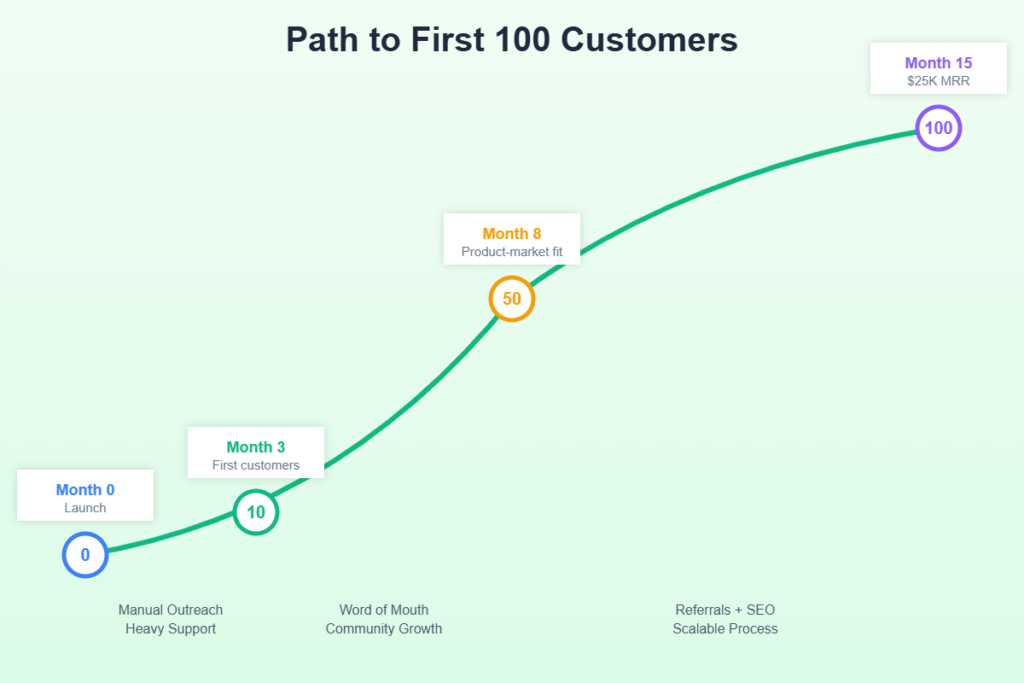
Getting your first 100 customers in a niche market follows a pattern:
Customers 1-10 (Months 1-3): Manual outreach, personal demos, heavy hand-holding. These customers teach you the business.
Customers 11-50 (Months 4-8): Word-of-mouth referrals, community presence, early content marketing. You’re becoming known in the niche.
Customers 51-100 (Months 9-15): Referral programs kick in, SEO starts working, sales process becomes predictable. You’ve achieved product-market fit.
At 100 customers averaging $250/month, you’re at $25,000 MRR ($300K ARR)—a milestone that proves market viability and typically enables full-time focus.
Resources for Building Your Niche AI SaaS
Recommended Reading
- “The Mom Test” by Rob Fitzpatrick – Essential guide to customer development interviews
- “Obviously Awesome” by April Dunford – Positioning strategies for niche products
- “Traction” by Gabriel Weinberg – Finding your customer acquisition channel
Tools & Platforms
AI Development:
- OpenAI API, Anthropic Claude API, Google Gemini – General-purpose AI
- AssemblyAI, Deepgram – Speech recognition
- Roboflow, Google Cloud Vision – Computer vision
- LangChain – AI orchestration framework
No-Code/Low-Code:
- Bubble, Webflow – Frontend builders
- Retool, AppSmith – Internal tool builders
- Zapier, Make – Workflow automation
- Supabase, Xano – Backend services
Business Operations:
- Stripe, Paddle – Payments and billing
- Intercom, Crisp – Customer support
- PostHog, Amplitude – Product analytics
- Ahrefs, SEMrush – SEO and market research
Communities & Learning
- Indie Hackers – Community of bootstrapped founders
- MicroConf – Conference for self-funded SaaS founders
- r/SaaS – Reddit community for SaaS builders
- SaaS Subreddit Communities – Niche-specific founder groups
Conclusion: Your Niche AI SaaS Opportunity Awaits
The opportunity in underserved markets for ai saas ideas has never been more accessible or more lucrative. While the tech giants compete for horizontal markets, countless niche industries desperately need specialized AI solutions that understand their unique workflows, terminology, and challenges.
The small underserved markets for ai saas ideas we’ve explored—from funeral homes to marinas, from pet groomers to court reporters—represent just the beginning. Thousands of similar opportunities exist for founders willing to:
- Dig deep into industry pain points
- Build specialized solutions rather than generic platforms
- Become trusted partners within niche communities
- Iterate quickly based on direct user feedback
- Dominate small markets before expanding
The democratization of AI technology through accessible APIs, pre-trained models, and no-code platforms means you don’t need a PhD in machine learning or a million-dollar budget. You need domain expertise, customer obsession, and the willingness to solve real problems for real people.
Remember: the most successful niche ai saas ideas for small underserved markets often come from unexpected places. The next great AI SaaS company might serve podiatrists, storage facility operators, or mobile notaries. It might generate $5M ARR serving just 2,000 customers. It might be built by a solo founder in 90 days using no-code tools.
That company could be yours.
The question isn’t whether opportunities exist in underserved markets—they absolutely do. The question is: which niche will you choose to dominate?
Ready to Build Your Niche AI SaaS?
If you’re serious about exploring ai saas ideas for small underserved markets 2026, here are your immediate next steps:
- Choose one niche from this article or identify your own using the frameworks provided
- Conduct 10 customer interviews this week to validate pain points
- Join the relevant industry communities where your target customers congregate
- Map the competitive landscape to understand existing solutions and gaps
- Define your MVP scope focusing on the single most painful problem
Don’t wait for perfect conditions or complete clarity. The best time to start building is now, when AI technology is accessible, niche markets are underserved, and first-mover advantages still exist.
For more insights on building successful SaaS businesses, explore our comprehensive guides on SaaS development, growth strategies, and market research techniques.
Your niche is waiting. Go find it, understand it deeply, and build something that makes a real difference for a specific group of people who desperately need what only you can create.
About SaaSHints: We help entrepreneurs and businesses navigate the complex world of SaaS development, growth, and optimization. Visit our homepage for more actionable insights on building profitable software businesses.
1 thought on “Underserved Markets for AI SaaS Ideas: 13 Profitable Niches for 2026”