
The software industry has undergone a remarkable transformation over the past two decades, and at the heart of this evolution lies Software-as-a-Service. From small startups to Fortune 500 enterprises, businesses worldwide have embraced cloud-based software solutions that promise flexibility, scalability, and cost-effectiveness.
But just how big is the SaaS industry? With the global market forecasted to reach around $1,251.35 billion by 2034, the sector shows no signs of slowing down. Whether you’re a founder considering entering this space, an investor looking for opportunities, or simply curious about one of tech’s fastest-growing sectors, understanding the current landscape is essential.
In this comprehensive guide, we’ll explore everything from market size and growth projections to the number of companies operating globally and what makes the most profitable players stand out. We’ll also examine why this industry continues to thrive and what challenges lie ahead. If you’re curious about how SaaS companies make money, we’ve covered that in detail as well. Let’s dive into the numbers that define the SaaS revolution.
What Is the SaaS Industry?
The SaaS industry encompasses all companies that deliver software applications over the internet on a subscription basis. Instead of purchasing software licenses and installing programs on individual computers, users access applications through their web browsers or mobile devices.
Unlike traditional software that requires physical installation, ongoing maintenance, and expensive upgrades, SaaS solutions are hosted on cloud servers and maintained by the provider. Users simply log in, pay a recurring fee, and access the latest features without worrying about technical infrastructure.
The industry serves three primary market segments:
B2B SaaS: Business-to-business solutions like Salesforce, Slack, and HubSpot that help companies streamline operations, manage customer relationships, and collaborate effectively.
B2C SaaS: Consumer-focused platforms like Netflix, Spotify, and Dropbox that provide entertainment, productivity, and storage solutions directly to individual users.
Vertical SaaS: Industry-specific software tailored for sectors like healthcare, real estate, construction, or legal services, addressing unique pain points that general solutions can’t solve.
This flexibility in delivery models has made SaaS the dominant force in modern business software.
How Many SaaS Companies Are There?
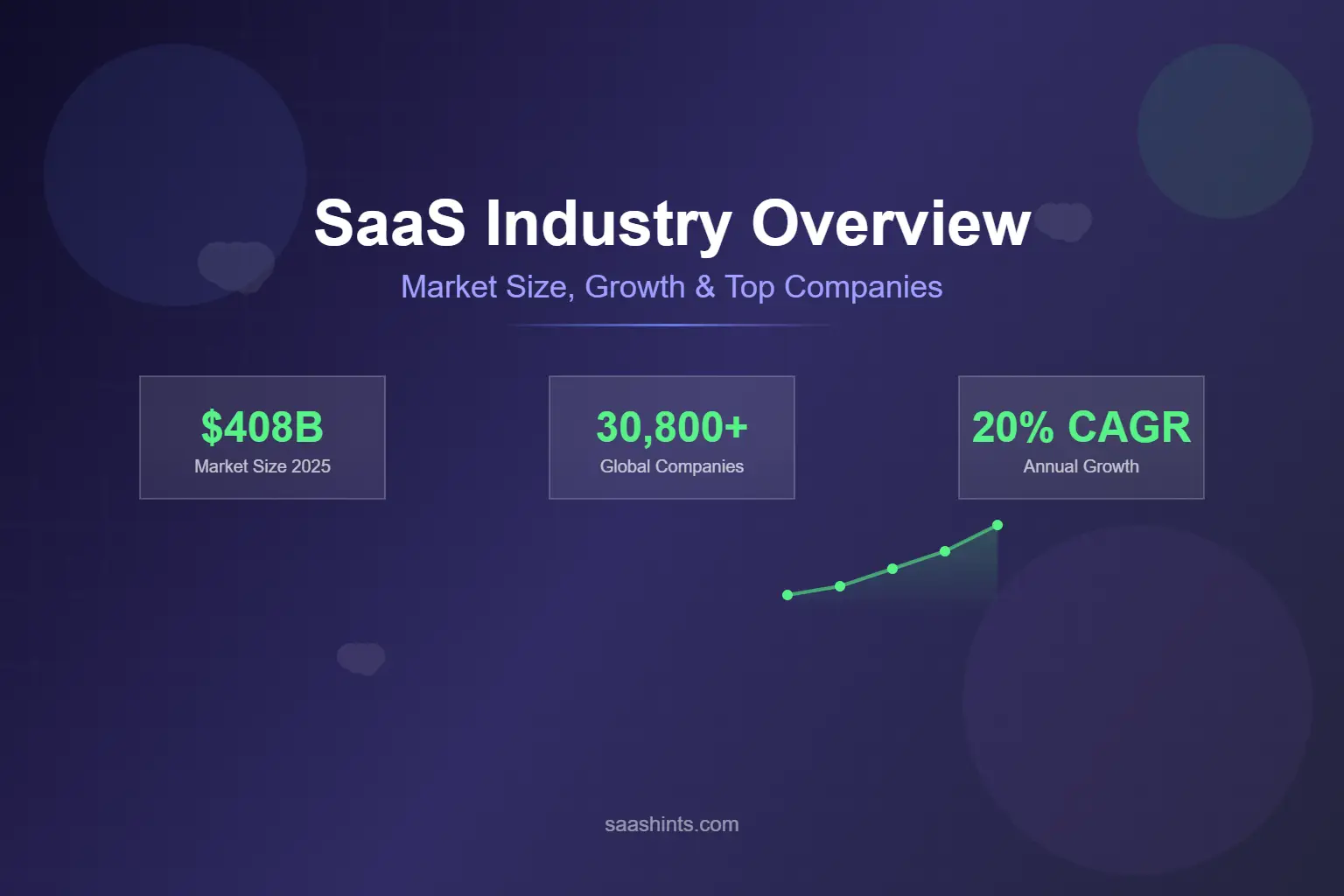
The SaaS ecosystem has exploded in recent years. There are over 30,800 SaaS companies worldwide, representing a significant increase from just a few years ago.
The growth trajectory tells an interesting story about entrepreneurship and innovation. The barrier to entry has never been lower thanks to cloud infrastructure, development tools, and accessible funding. This has sparked a wave of new entrants trying to carve out their niche in the market.
Breaking down the numbers by company maturity, we see two distinct trends:
Startup Growth: Thousands of new SaaS startups launch each year, with many focusing on micro-SaaS solutions that solve specific problems for targeted audiences. The SaaS sector is home to about 17,000 companies in North America alone, demonstrating the vibrant startup ecosystem.
Enterprise SaaS: Established players continue to dominate market share, with companies like Microsoft, Salesforce, and Adobe commanding significant portions of the industry revenue.
How Many SaaS Companies Are There in the World?
When we look at the global distribution, the concentration becomes clear. A large share of these companies, totaling 12,400, are located in the United States, making America the undisputed leader in SaaS development.
Following the United States, the remaining top countries by number of SaaS companies include the United Kingdom with 1,700 companies, Canada with 1,100, India with 1,100, and Germany with 916.
The number keeps increasing for several compelling reasons:
Cloud Infrastructure Accessibility: Services like AWS, Google Cloud, and Microsoft Azure have made it possible for developers anywhere in the world to launch sophisticated applications without massive capital investments.
Low Entry Barriers: Modern development frameworks, no-code platforms, and readily available technical talent mean a small team can build and launch a viable SaaS product in months rather than years.
Global Market Reach: Unlike traditional software that required physical distribution, SaaS companies can instantly serve customers worldwide, creating opportunities in emerging markets.
Niche Specialization: As horizontal SaaS platforms mature, entrepreneurs are finding success by building vertical solutions for specific industries or addressing particular workflow challenges.
SaaS Market Size & Industry Growth
The financial scale of the SaaS industry is staggering. The global software as a service (SaaS) market size is calculated at $408.21 billion in 2025, reflecting the enormous value businesses place on cloud-based solutions.
The growth trajectory is equally impressive. The market is projected to grow from $315.68 billion in 2025 to $1,131.52 billion by 2032, exhibiting a CAGR of 20.00%, which means the industry will more than triple in less than a decade.
Several factors are driving this explosive adoption:
Cost Efficiency: Companies save money on hardware, IT staff, and maintenance while gaining access to enterprise-grade software.
Remote Work Revolution: The shift to distributed teams has made cloud-based collaboration tools essential rather than optional.
Digital Transformation: Organizations across all industries are modernizing their operations, with SaaS at the center of these initiatives.
Scalability: Businesses can start small and scale their software usage as they grow, paying only for what they need.
SaaS Industry Growth Trends
Looking at the trends shaping the future, several themes emerge:
AI-Powered SaaS: Artificial intelligence is no longer a nice-to-have feature. The global AI SaaS market is valued at $101.73 billion in 2025, and most new SaaS products now include intelligent automation, predictive analytics, or natural language processing capabilities.
Remote Work Tools: Even as some companies return to offices, the demand for collaboration platforms, project management software, and virtual communication tools remains strong. Organizations now use an average of 112 SaaS apps, demonstrating how deeply embedded these tools have become in daily workflows.
Industry-Specific SaaS: Vertical SaaS continues to gain traction as businesses seek solutions designed specifically for their sector’s unique requirements. Healthcare, construction, legal, and financial services are seeing particularly strong growth in specialized software.
Subscription-Based Economy: The recurring revenue model has proven its value, with up to 70% of apps being SaaS-based, and by 2025, that number is expected to rise to 85%.
Most Profitable SaaS Companies
While thousands of companies compete in this space, a select group dominates profitability. The most successful SaaS businesses share several characteristics:
Microsoft: With Office 365 and Azure cloud services, Microsoft’s Azure alone is estimated to reach $76 billion in annual revenue by 2025, making it one of the industry’s biggest players.
Salesforce: As a pioneer of the SaaS model, Salesforce is one of the largest SaaS companies today, with a market cap exceeding $262 billion in 2025.
OpenAI: The AI revolution has created new SaaS giants. OpenAI has an annualized run rate of $10 billion as of June 2025 and is on track to hit $12.7 billion for the year.
Netflix: Demonstrating the B2C potential, Netflix is the world’s most popular video streaming service with over 300 million paid subscribers in 2025.
Common traits among top performers include:
Strong Product-Market Fit: They solve real problems that customers are willing to pay for consistently.
High Net Revenue Retention: The best companies not only keep customers but expand revenue from existing accounts through upsells and feature adoption.
Efficient Go-to-Market Strategy: They’ve mastered customer acquisition while maintaining reasonable costs.
Enterprise vs SMB Focus: Enterprise SaaS typically offers higher contract values and longer customer lifetimes, while SMB-focused solutions win through volume and rapid scaling. Companies with greater than $50M ARR are achieving $400k in ARR per full-time employee, showing remarkable efficiency at scale.
Why the SaaS Industry Is Growing So Fast
The explosive growth of SaaS isn’t accidental. Several structural advantages make this business model superior to traditional software:
Recurring Revenue Model: Instead of one-time purchases, SaaS companies generate predictable monthly or annual revenue streams. This creates financial stability and makes business planning more accurate.
Scalability: Once built, SaaS products can serve one customer or one million with minimal incremental cost. This scalability enables rapid expansion without proportional increases in expenses.
Global Reach: Geographic boundaries barely exist in the cloud. A company in San Francisco can serve customers in Singapore, Sydney, or Stockholm simultaneously without opening local offices.
Lower Operational Costs: Companies eliminate expenses associated with physical distribution, installation support, and on-premise maintenance. Updates happen automatically, and support can be delivered digitally at scale.
The combination of these factors creates a powerful economic model that benefits both providers and customers, fueling continued industry expansion. To understand more about what SaaS companies do and how they work behind the scenes, check out our detailed breakdown.
SaaS Industry Challenges
Despite impressive growth, the SaaS sector faces significant obstacles:
Market Saturation: With over 30,800 SaaS companies worldwide, standing out has become increasingly difficult. Many categories now have dozens of competitors offering similar features.
High Competition: Customers have abundant choices, raising their expectations for product quality, user experience, and customer service. New SaaS apps, tools, and products are constantly being released, which makes it harder for a SaaS business to stand out.
Rising Customer Acquisition Costs: As competition intensifies, the cost to acquire new customers continues climbing. Companies must invest more in marketing, sales, and product differentiation to grow.
Churn and Retention Issues: Nearly 70% of new users stop using software within three months, highlighting the challenge of user retention. B2B SaaS firms are seeing an average monthly churn rate of 3.5% in 2025, which can significantly impact long-term growth.
Security Concerns: 83% of organizations reported experiencing at least one insider attack in the past year, making cybersecurity a critical priority. Data breaches can destroy trust and reputation overnight.
SaaS Sprawl Management: Studies show that nearly 50% of SaaS licenses go unused for 90 days or more, creating waste and increasing security risks for customer organizations.
Future of the SaaS Industry
Looking ahead, several predictions shape the industry’s trajectory over the next five to ten years:
AI Integration Becomes Standard: Artificial intelligence will move from differentiator to baseline expectation. The AI SaaS market is projected to grow at a CAGR of 39.4% between 2025 and 2032, indicating rapid adoption across all software categories.
Vertical SaaS Expansion: Industry-specific solutions will continue gaining market share as businesses seek purpose-built tools rather than adapting general platforms. The global Vertical SaaS market will reach $720.44 billion by 2028, growing at a 25.89% CAGR.
Consolidation and Acquisitions: As the market matures, expect more mergers and acquisitions. Larger players will buy innovative startups to expand their capabilities, while smaller companies will combine to compete more effectively.
Enhanced Security Measures: With cyber threats escalating, security features will become major selling points. Companies that demonstrate strong data protection and compliance will win customer trust.
Micro-SaaS Growth: Modern micro-SaaS teams operate with one to three people, focusing on one killer workflow rather than all-in-one platforms, suggesting opportunities for focused, lean operations.
Pricing Innovation: Usage-based and consumption pricing models will gain popularity alongside traditional subscriptions, allowing customers to pay for actual value received.
Is the SaaS Industry Still Worth Entering?
Despite increased competition, the SaaS industry offers substantial opportunities for new founders who approach it strategically.
Opportunities for New Founders:
The market’s growth means there’s still plenty of room for innovation. The global software as a service (SaaS) market size is forecasted to reach around $1,251.35 billion by 2034, indicating sustained expansion for years to come.
Success today requires differentiation. Generic solutions face tough competition, but founders who identify underserved niches or bring novel approaches to existing problems can build thriving businesses.
Best Niches to Enter:
Vertical SaaS: Industry-specific software for healthcare, construction, legal services, real estate, and other sectors with unique workflows offers better defensibility than horizontal solutions.
AI-Enhanced Tools: Products that leverage artificial intelligence to automate complex tasks or provide intelligent insights have strong market pull.
Integration Platforms: As companies use more tools, solutions that connect and synchronize different systems solve a growing pain point.
Compliance and Security: With regulations tightening globally, software that helps companies stay compliant has clear value propositions.
Advice for Beginners:
Start narrow and focused. It’s better to dominate a small niche than to compete weakly in a broad market. Validate your idea thoroughly before building by talking to potential customers and understanding their pain points deeply.
Focus on retention from day one. Acquiring customers is expensive, so making them successful and keeping them is crucial. Build with user experience in mind, invest in customer support, and continuously improve based on feedback.
Consider the economics carefully. Understand your customer acquisition cost, lifetime value, and time to profitability. The two strongest predictors of long term and profitable growth are CAC payback period and net revenue retention.
Conclusion
The SaaS industry stands as one of the most dynamic and promising sectors in technology. With the market valued at over $400 billion today and projected to exceed $1.2 trillion by 2034, the opportunity for growth remains substantial.
From 30,800+ companies worldwide serving every conceivable business need to industry giants generating billions in annual revenue, the ecosystem demonstrates both maturity and continued innovation. The most successful players combine strong product-market fit, efficient operations, and relentless focus on customer success.
While challenges like market saturation, rising acquisition costs, and retention issues are real, they’re not insurmountable. Smart founders who identify underserved niches, build genuinely valuable solutions, and execute with discipline can still build thriving businesses.
Whether you’re exploring SaaS as an entrepreneur, investor, or curious observer, understanding this industry’s fundamentals is essential. The companies that will thrive in the next decade will be those that adapt to emerging trends like AI integration, focus on specific verticals, and prioritize customer outcomes above all else.
Ready to dive deeper? Explore our complete SaaS knowledge hub for more guides on building, scaling, and succeeding in the software industry. You can also learn more about how SaaS companies generate revenue and what successful SaaS businesses do to stay competitive.
FAQ Section
How many SaaS companies exist worldwide?
There are over 30,800 SaaS companies worldwide, with the United States leading with approximately 12,400 companies, followed by the United Kingdom, Canada, India, and Germany.
Is the SaaS market saturated?
While certain categories show high competition, the market continues growing substantially. The market is projected to grow from $315.68 billion in 2025 to $1,131.52 billion by 2032. Opportunities remain, particularly in vertical SaaS and emerging technology integrations like AI. Success requires strong differentiation and focus on specific customer needs.
Which SaaS companies are most profitable?
The most profitable SaaS companies include Microsoft (with Azure and Office 365), Salesforce, OpenAI, Netflix, Adobe, and Google. These companies combine strong product-market fit, efficient operations, and high customer retention to generate substantial profits.
Is SaaS still growing in 2025?
Absolutely. The global Software as a Service (SaaS) market size is projected to grow from $315.68 billion in 2025 to $1,131.52 billion by 2032, exhibiting a CAGR of 20.00%. The industry shows no signs of slowing, driven by digital transformation, remote work, AI integration, and continued cloud adoption.
1 thought on “SaaS Industry Overview: Market Size, Growth & Top Companies”